Table of Contents
- Quick Range Hood Sizing Guide
- Why does a Wider Range Hood Perform Better?
- Do Island Range Hoods Need to Be Wider?
- How Wide Should a Range Hood Be?
- How High Should a Range Hood Be Above the Cooktop?
- How Many CFM Does Your Range Hood Need?
- Range Hood Types & Sizing Breakdown
- Important Technical Considerations
- Common Range Hood Sizing Mistakes to Avoid
- FAQs
At The Range Hood Store, we regularly guide homeowners and contractors through every step of selecting the ideal range hood. The first thing we tell folks when choosing a range hood is that having an understanding of range hood sizes will help get the dimensions right.
A hood must be wide enough, powerful enough, and installed at the correct height to effectively capture smoke, grease, steam, heat, and lingering cooking odors.
A hood that is too narrow lets airborne grease settle across your cabinetry.
A hood mounted too high fails to capture rising heat plumes.
Selecting a range hood based solely on cooktop width can leave a modern high-BTU output gas range under-ventilated.
This guide breaks down range hood sizes and how to size wall mount, island, under cabinet, and insert range hoods using three core metrics:
The width of the cooking surface
The distance between the cooktop and hood
The total heat output (BTUs) of the range or cooktop
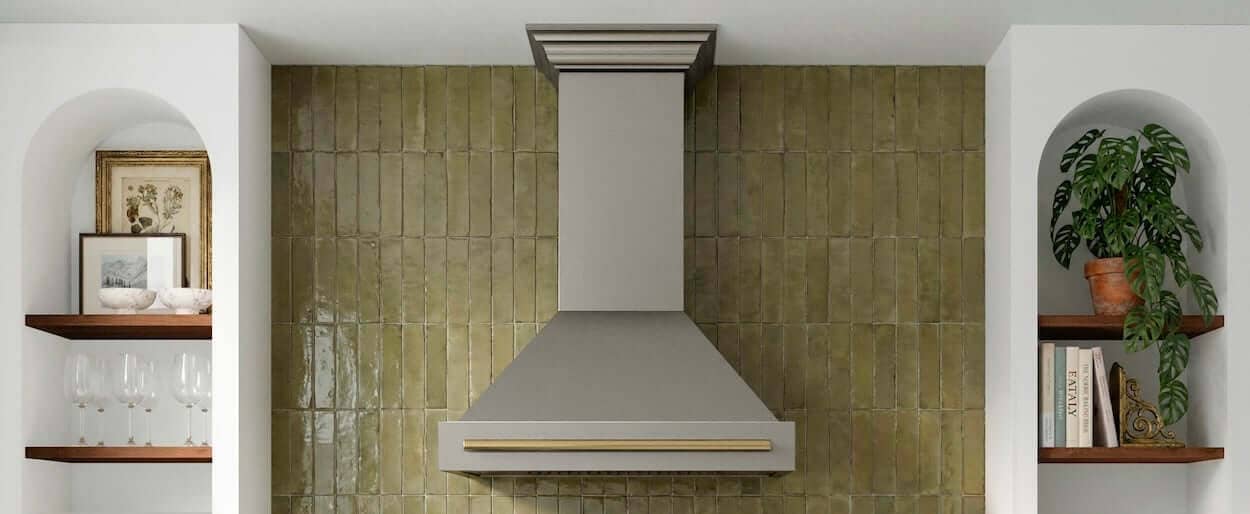
Quick Range Hood Sizing Guide
For most residential kitchens, start with these general sizing recommendations:
Cooking Surface Width | Recommended Wall / Under Cabinet Range Hood Sizes | Recommended Island Range Hood Sizes |
24 inches | 24 to 30 inches | 30 to 36 inches |
30 inches | 30 to 36 inches | 36 to 42 inches |
36 inches | 36 to 42 inches | 42 to 48 inches |
48 inches | 48 to 54 inches | 54 to 60 inches |
60 inches | 60 to 66 inches | 66 inches |
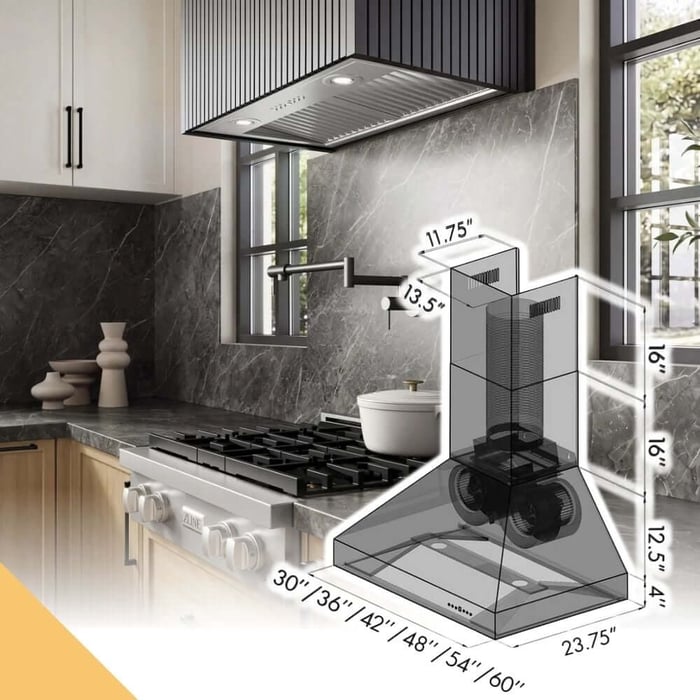
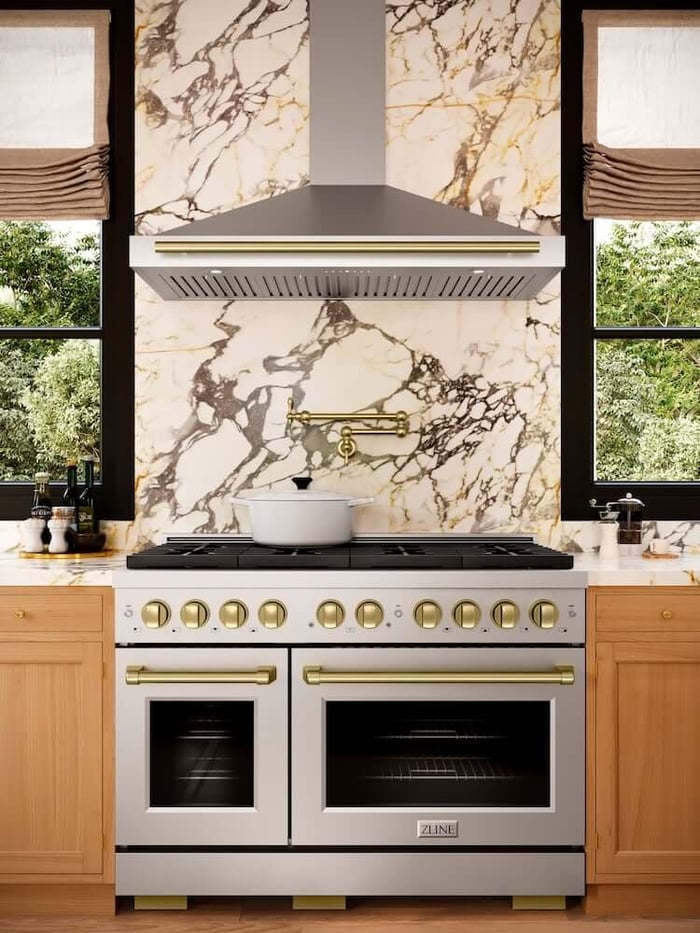
As a rule, your range hood should be at least as wide as the cooking surface.
Whenever cabinet layout and overhead space allow, we generally recommend choosing a hood that extends 3 inches beyond each side because the extra width dramatically improves capture efficiency.
Choosing a range hood that extends 3 inches wider than your cooktop on both the left and right sides makes the overall hood 6 inches wider than the cooking surface itself.
Common Examples:
30-inch cooktop (e.g., FCIND-30) → 36-inch range hood (e.g., KB-36)
36-inch cooktop → 42-inch range hood
48-inch range → 54-inch range hood
Why does a Wider Range Hood Perform Better?
Smoke, steam, and airborne grease do not rise in a perfectly straight line. Air currents from open windows, ceiling fans, or nearby HVAC vents push cooking plumes outward.
Extra range hood width makes a significant difference.
A wider hood canopy provides a larger collection area, trapping grease and smoke before they escape into your living space.
While a wider hood provides optimal coverage, space constraints (such as pre-existing upper cabinetry) mean many people select a hood matching their exact cooktop width.
Matching a hood with cooktop width is OK! A high-quality wall mount or under cabinet range hood that is the same width as the cooktop will perform well in most instances, just not as well as a wider one.
But remember, at minimum, a hood should never be narrower than the cooking surface below it.
Do Island Range Hoods Need to Be Wider?
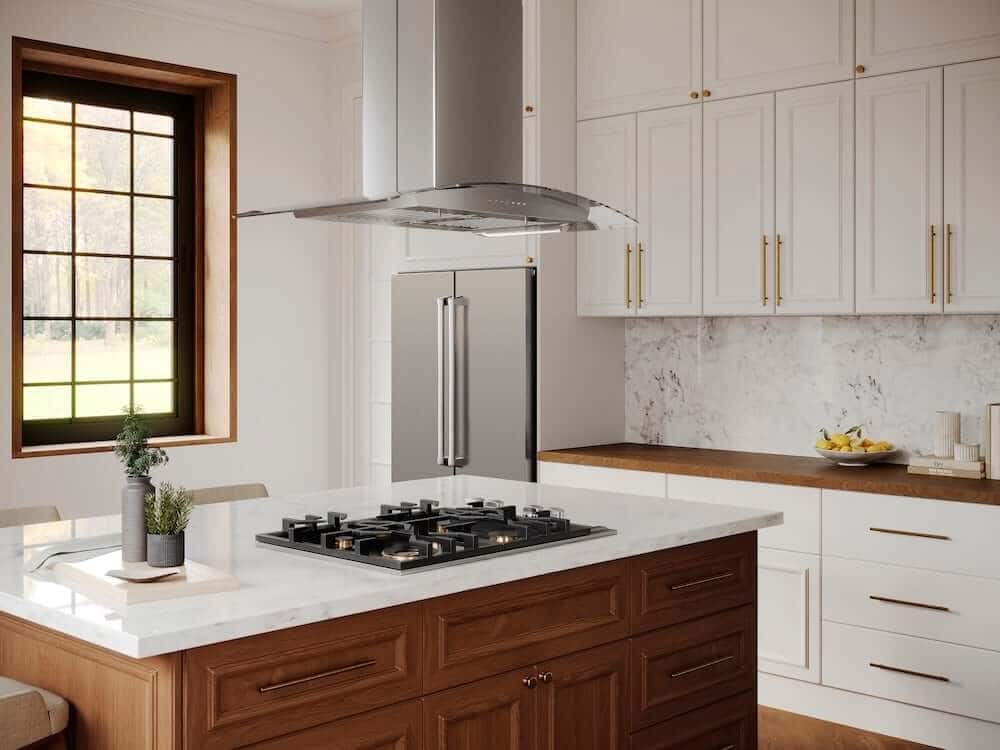
Yes. Island range hoods usually require greater coverage because they lack surrounding walls and cabinets to contain the plume.
A cooktop that is near a wall benefits from a backsplash and upper cabinets that naturally funnel smoke upward, while an island with a cooktop is fully exposed to cross-drafts from every angle.
30-inch island cooktop → Pair with a 36-inch or 42-inch island hood (such as the GL1i-36).
36-inch island cooktop → Pair with a 42-inch or 48-inch island hood (such as the KE2i-42).
The Home Ventilating Institute (HVI) recommends higher airflow rates for island setups: approximately 100 CFM per linear foot for wall installations vs. 150 CFM per linear foot for island installations. We’ll explain more about CFM later.
How Wide Should a Range Hood Be?
When choosing a hood width at The Range Hood Store, consider:
Cooktop width and fuel type
Hood placement (Wall, Island, Under-Cabinet, or Insert)
Burner layout (front vs. rear heavy usage)
Total BTU output
Kitchen design and cabinet spacing
Minimum Recommended Width
Match the hood width to the range width:
30-inch range → 30-inch hood minimum
36-inch range → 36-inch hood minimum
48-inch range → 48-inch hood minimum
This 1:1 ratio works for electric, induction, or moderate gas cooking when installed at proper mounting heights.
Preferred Recommended Width
Select a hood 6 inches wider than the range (3 inches of overhang on each side) if you:
Use high-BTU output gas ranges (e.g., DuoPro™ Ranges).
Cook frequently with front burners, woks, griddles, or indoor grills.
Have an open-concept kitchen or island cooktop.
Sear meats, deep fry, or generate high moisture/smoke volumes.
Can a Range Hood Be Too Wide?
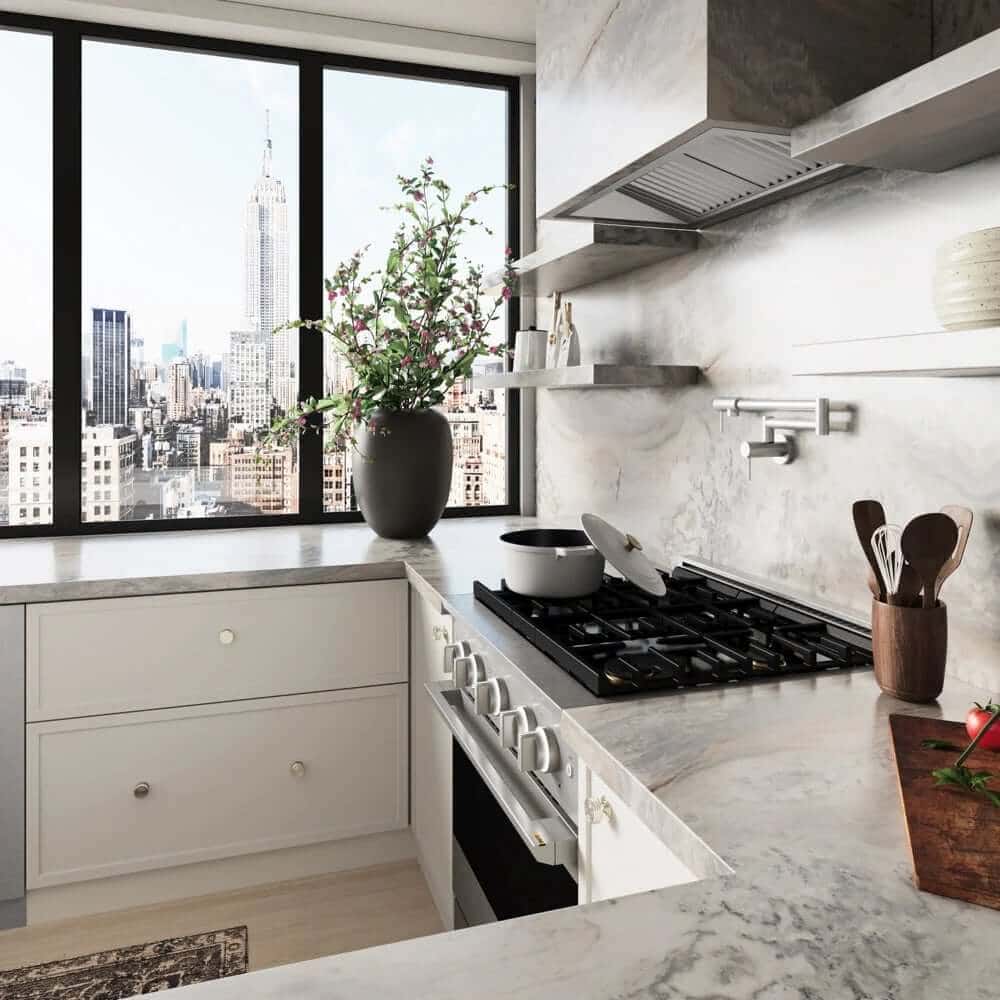
Wider range hoods do not harm performance, but they can create design bottlenecks that overwhelm compact kitchens, require costly cabinet modifications, or interfere with upper cabinet door swings.
Aim for a balanced look that complements your kitchen's scale while maintaining recommended clearances.
How High Should a Range Hood Be Above the Cooktop?
You can read our guide on range hood height here. The industry-standard mounting height for residential range hoods is between 24 and 30 inches above the cooking surface, but this recommendation varies depending on the fuel source, hood style, and manufacturer specifications.
Recommended Range Hood Height Guidelines
Cooking Appliance Type | Recommended Hood Height |
Electric/Induction Cooktop | 20 to 30 inches |
Standard Gas Cooktop | 24 to 30 inches |
Professional Gas Cooktop | 30 to 36 inches |
Outdoor / Patio Grill | 36 to 42 inches |
Note: Always review your specific model's user manual. ZLINE range hoods, for instance, typically specify a mounting distance of 24 to 30 inches for gas cooktops and 20 to 24 inches for electric cooktops to maintain warranty standards and peak performance.
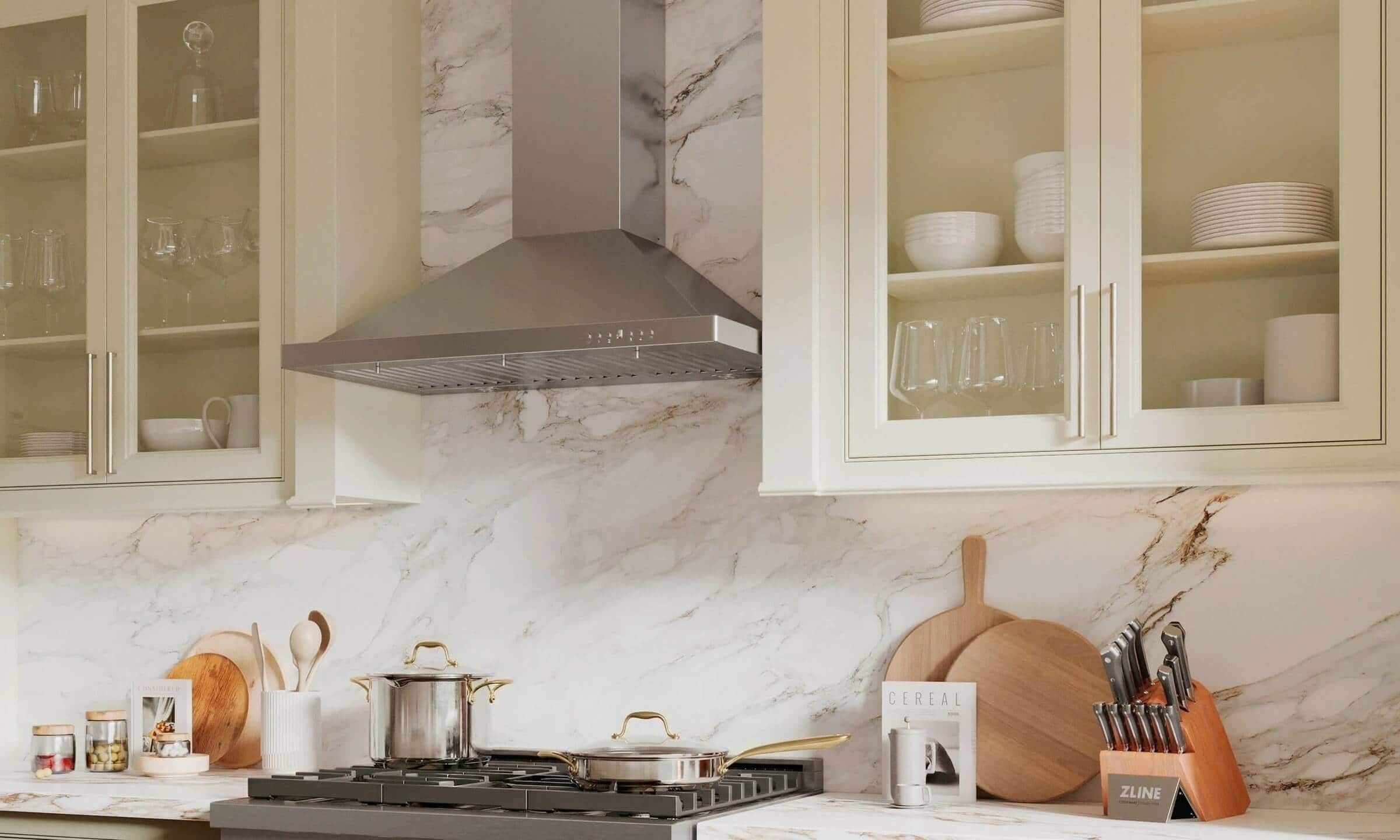
Risks of Mounting Too High
Mounting a hood beyond 30 to 36 inches dilutes capture efficiency.
As cooking plumes rise higher, they expand.
A hood installed too high will let steam and grease bypass the filters, requiring higher CFM blowers or wider canopies to compensate.
Risks of Mounting Too Low
Mounting a hood below 20 to 24 inches creates safety hazards:
Risk of thermal damage to internal electronics and LED lighting.
Obstruction of rear burner access and reduced cooking visibility.
Fire hazards from open flames on high-output gas burners.
Head-clearance issues while standing over the stove.
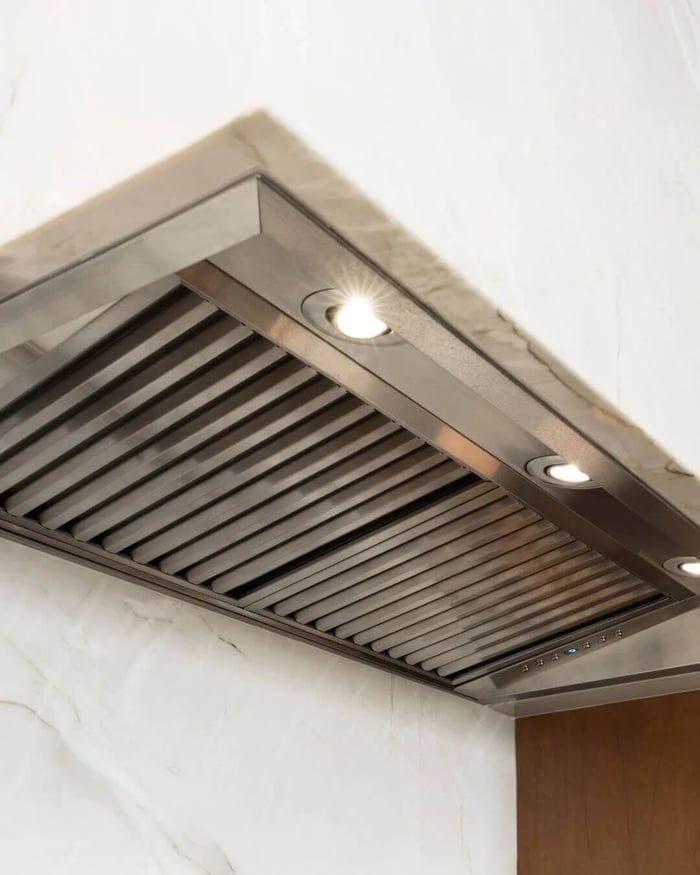
How Many CFM Does Your Range Hood Need?
CFM (Cubic Feet per Minute) measures how much air volume a range hood motor can move.
It's a key number that tells you how powerful the hood is when it comes to moving air.
You can read our simple guide to calculating the proper CFM to ensure your ventilation system effectively exchanges smoky air without unnecessary noise or energy waste.
Range Hood Types & Sizing Breakdown
1. Wall Mount Range Hoods
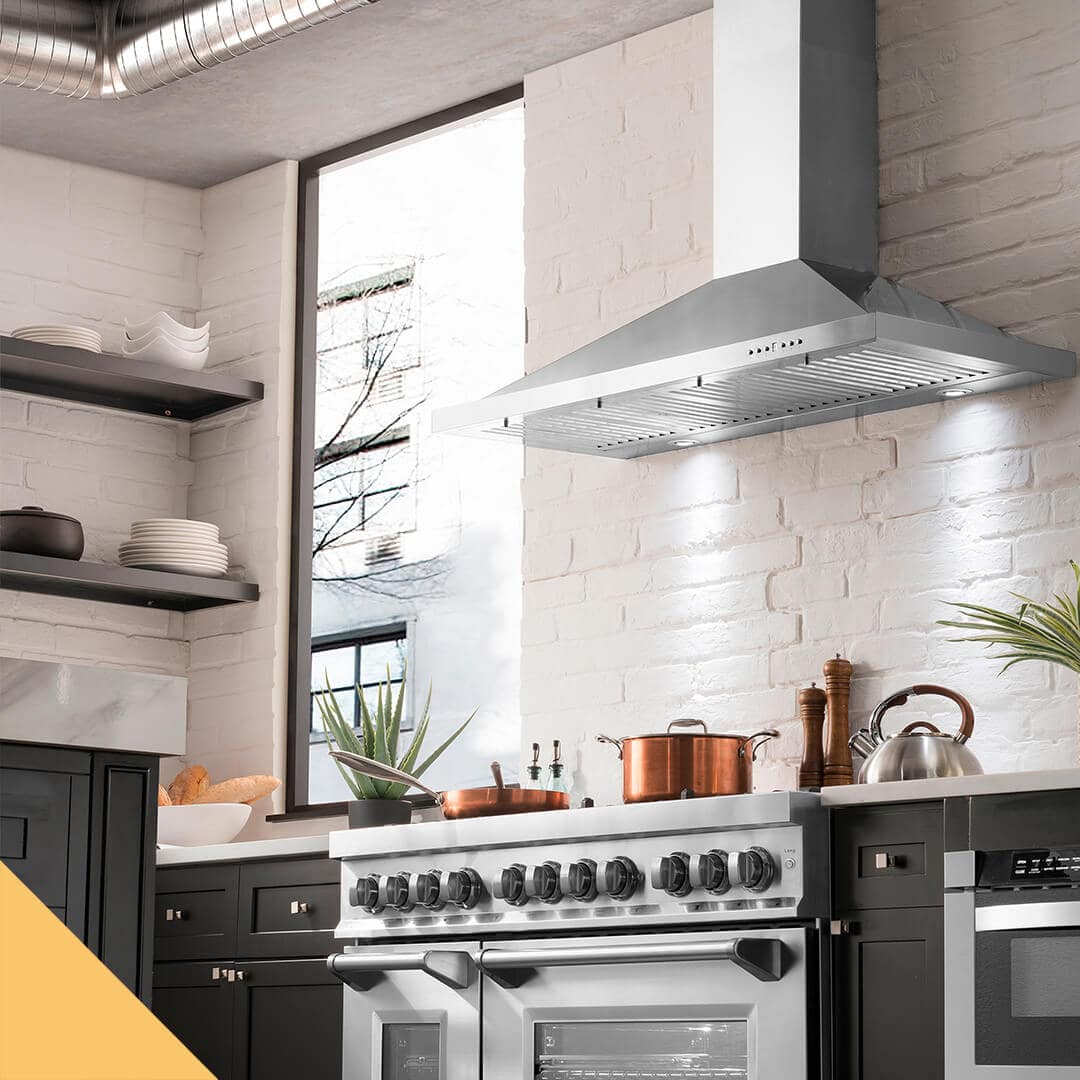
Wall mount hoods install directly onto the wall above the cooktop, featuring a decorative telescopic chimney to enclose the ductwork up to the ceiling. These are also often called chimney hoods.
The sizing rule for wall mount range hoods is to match the cooktop width or add 3 inches per side.
ZLINE Convertible Vent Wall Mount Range Hood in Stainless Steel (KB)
$323.99
$359.99
The ZLINE Convertible Vent Wall Mount Range Hood in Stainless Steel (KB) provides a professional culinary experience by pairing built-to-last quality with a timeless style. Achieve ZLINE Attainable Luxury® excellence with unrivaled performance that enhances your kitchen’s capabilities. This product… Read More

2. Island Range Hoods
Island mount range hoods are suspended entirely from ceiling joists and are usually chosen to serve as central focal points in open-concept kitchens.
It’s important not to confuse island range hoods with ceiling range hoods, which install flush with the ceiling and require special width and CFM consideration. Contact our range hood experts for assistance with selecting a ceiling range hood.
The sizing rule for island mount range hoods is to select a canopy wider than the cooktop whenever possible (e.g., pair a 36-inch cooktop with a 42-inch island hood).
ZLINE Convertible Vent Island Mount Range Hood in Stainless Steel (GL2i)
$637.49
$749.99
Unite modernity and everlasting quality with the ZLINE Convertible Vent Island Mount Range Hood in Stainless Steel (GL2i). The high-performance 400 CFM, 4-speed motor provides all the power you need to quietly and efficiently ventilate your kitchen while cooking. Modern… Read More

3. Under Cabinet Range Hoods
Mounted beneath standard upper wall cabinets, under cabinet hoods are compact solutions for traditional space-saving layouts.
Because under cabinet range hoods are constrained by cabinet width and height, the sizing rule for under cabinet range hoods is to match the cooktop width or add 3 inches per side while paying close attention to overall hood height to maintain at least 24 inches of clearance over the cooktop.
ZLINE 600 CFM Ducted Under Cabinet Range Hood in Black Stainless Steel with Size Options (BS623)
$872.99
$969.99
Luxury isn’t meant to be desired - it’s meant to be attainable. The ZLINE 600 CFM Ducted Under Cabinet Range Hood in Black Stainless Steel (BS623) provides a professional culinary experience by pairing built-to-last quality with a timeless style. Achieve… Read More

4. Range Hood Inserts (AKA Hood Liners)
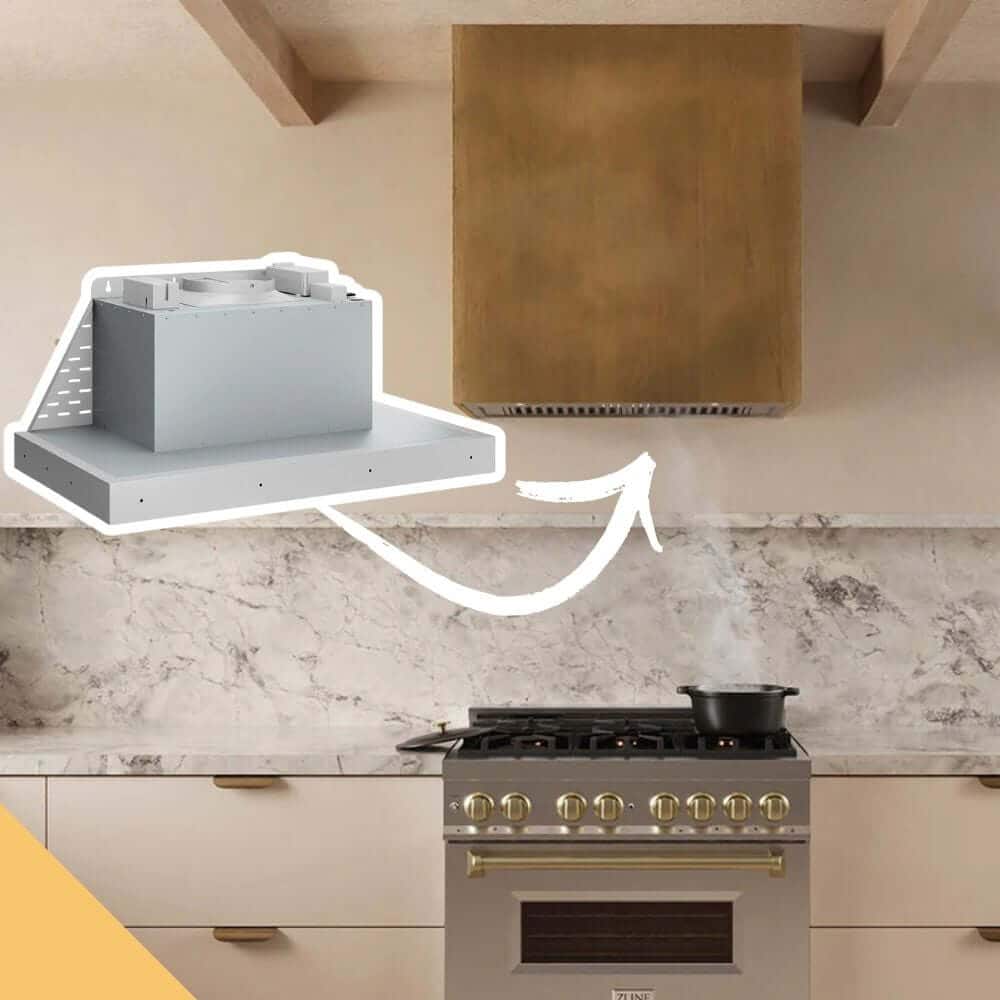
Insert hoods install hidden inside custom-built enclosures made of wood, tile, plaster, or masonry. The insert provides the blower, filters, controls, and lighting, while the custom shell defines the visual style.
The sizing rule for range hood inserts is to differentiate between insert size and custom enclosure size.
For example, a 48-inch custom wooden enclosure typically houses a 46-inch range hood insert to allow proper internal fit and structure.
ZLINE 40 in. DuraMount™ Wall Mount Range Hood Insert in Stainless Steel (683-40)
$815.99
$959.99
The ZLINE 40 in. DuraMount™ Wall Mount Range Hood Insert in Stainless Steel (683-40) combines powerful ventilation with a patented mounting design that brings attainable luxury to any custom kitchen layout. Featuring reinforced triangle supports with staggered, overlapping mounting points,… Read More

Important Technical Considerations
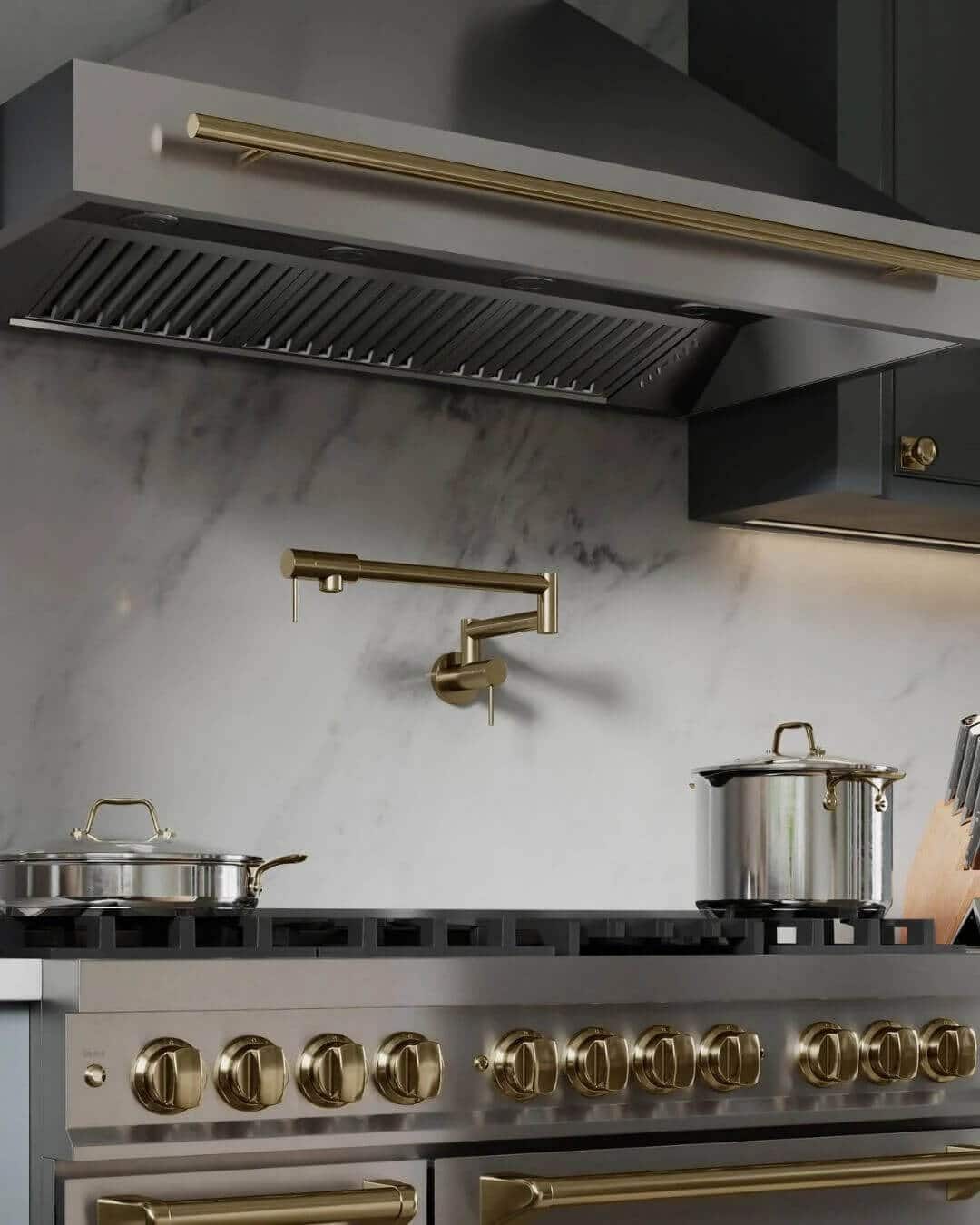
Ductwork Diameter & Layout
A high-CFM motor cannot overcome restricted ductwork.
400 CFM or less: Requires a minimum 6-inch round duct.
600 to 900 CFM: Requires a minimum 8-inch round duct.
1200+ CFM: Requires a minimum 10-inch round duct.
Use rigid, smooth-walled galvanized metal ducting rather than semi-rigid or flexible ducting. Keep runs as short and straight as possible; every 90-degree elbow adds the equivalent of 5 to 10 feet of airflow resistance.
Understanding Make-Up Air Requirements
High-capacity range hoods (typically those rated above 400 CFM) extract significant volumes of air.
In certain homes, this can create negative air pressure inside the residence.
In many places, building codes require a make-up air system if your range hood exceeds 400 CFM. This system brings fresh air into your home to balance out the air that the hood is removing.
Check local building codes before installing hoods over 400 CFM.
Ducted vs. Ductless Recirculating Sizing
While ducted hoods vent smoke, odors, and moisture outside, ductless setups pull air through charcoal filters and recirculate it back into the room.
If external ducting is impossible, many models sold at The Range Hood Store convert easily to ductless operation using custom charcoal filter kits. Note that recirculating air reduces effective CFM by 10% to 20% due to filter resistance, so sizing up your motor capacity is recommended.
Common Range Hood Sizing Mistakes to Avoid
Buying a hood narrower than your cooktop: Reduces capture rate and allows grease to collect on nearby cabinets.
Ignoring total range BTUs: Oversights here lead to underpowered ventilation over high-end gas cooktops.
Mounting the hood too high for visual aesthetics: Negates the motor's ability to capture rising heat plumes.
Reducing duct pipe size: Attaching a 1200 CFM motor to a 6-inch duct increases noise exponentially while reducing airflow by up to 50%.
Building a custom hood before purchasing the insert: Always select your insert liner first so your cabinet or shell maker has exact physical cut-out dimensions.
Ready to Find Your Perfect Range Hood?
Explore our extensive catalog of Wall Mount, Island, Under Cabinet, and Insert Range Hoods at The Range Hood Store. Contact our range hood experts today for personalized sizing assistance and professional project support.
Connect with us on social media!
Facebook: The Range Hood Store
Instagram: @therangehoodstore
YouTube: The Range Hood Store
Pinterest: @TheRangeHoodStore
FAQs
Should my range hood be wider than my stove?
While matching the exact width of your stove is acceptable in tight spaces, choosing a hood that extends 3 inches wider on each side (Rule of 3 Inches) offers superior smoke and grease capture.
What size hood do I need for a 30-inch range?
A 30-inch hood is the standard minimum choice. For high-heat gas cooking or open layouts, a 36-inch hood provides optimal coverage.
How high should a ZLINE range hood be installed above a gas stove?
ZLINE recommends installing wall mount and island range hoods between 24 and 30 inches above the cooking surface for gas ranges, and 20 to 24 inches for electric or induction cooktops.
How many CFM do I need for a 36-inch professional gas range?
Calculate total BTU output across all burners. For example, a 36-inch gas range producing 75,000 BTUs total requires a range hood rated at at least 750 CFM.
Why choose a ZLINE range hood from The Range Hood Store?
ZLINE Range Hoods offer premium craftsmanship, quiet performance, dishwasher-safe stainless steel baffle filters, and an industry-exclusive Lifetime Motor Warranty. At The Range Hood Store, our technical experts help you select the exact width, height, and blower capacity for your dream kitchen.